
Laser cleaning is a non-contact surface treatment process that uses a fiber laser beam to remove rust, paint, oxide layers and coatings from metal — without abrasives, without chemicals. The laser energy ablates the contamination while the base material remains largely intact when correct parameters are used.
Laser cleaning is a surface treatment process that uses a high-energy fiber laser beam to remove rust, paint, oxide layers, coatings and other contamination from metal surfaces — without abrasives, without chemicals, and without mechanical contact with the base material.
For industrial applications, laser cleaning is most often relevant in three situations: removing post-weld discoloration and heat-affected zone (HAZ) oxides on stainless steel, stripping rust or paint from structural steel before repair or recoating, and cleaning precision components or mould surfaces where abrasive methods would damage dimensional tolerances.
For a broader overview of fiber laser technology including welding and cutting applications, see the complete fiber laser welding guide.
What Is Laser Cleaning?
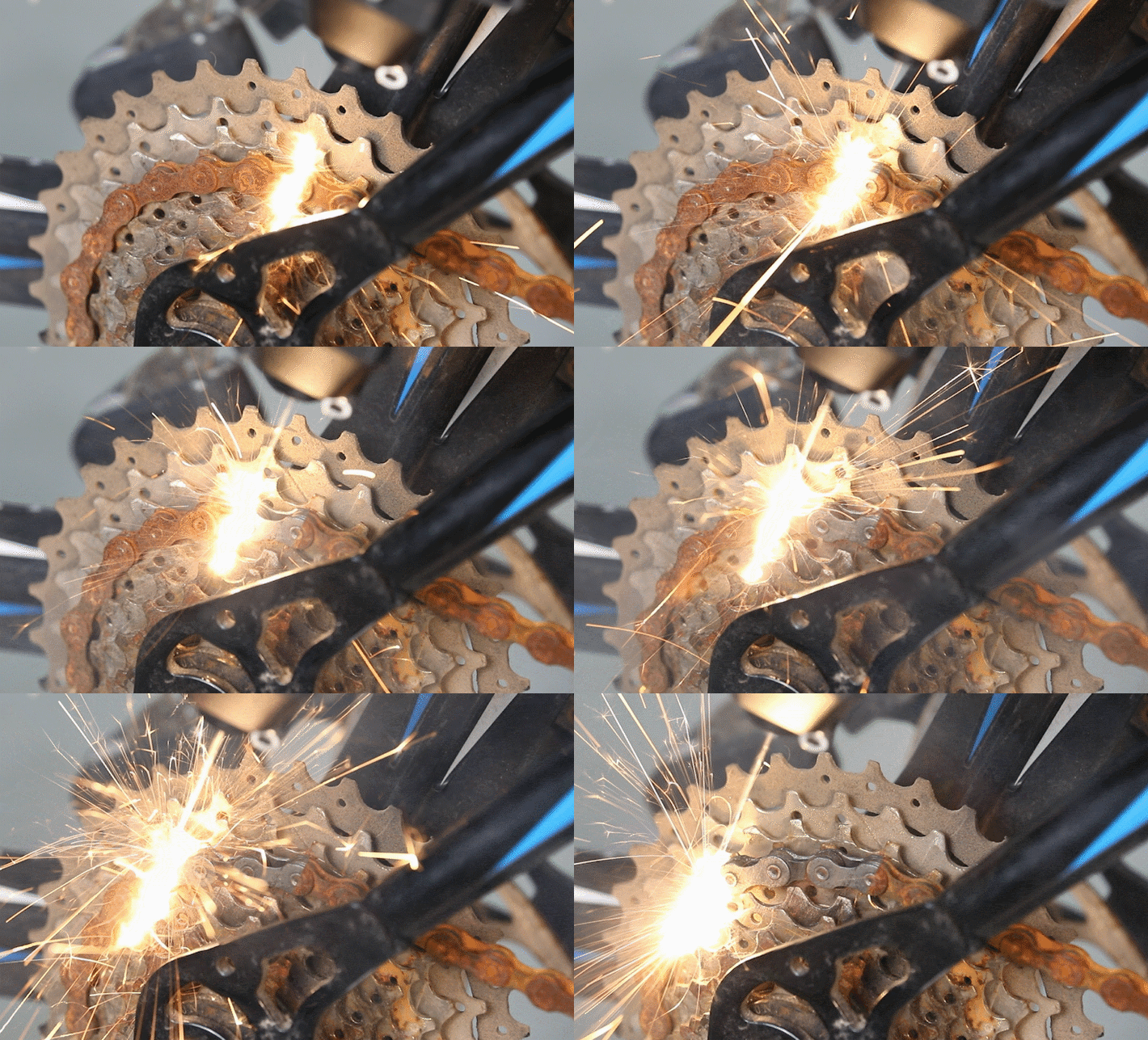
In practical terms, laser cleaning is a non-contact, dry surface cleaning method. A fiber laser beam — typically at 1070 nm wavelength — is scanned across the contaminated surface. The contamination absorbs the laser energy and is either vaporized directly or broken off as particles through a rapid thermal expansion process called ablation. The base metal, which absorbs the laser energy differently from the contamination layer, remains largely unaffected.
The result is a clean metal surface achieved without any of the consumables, waste streams, or dimensional changes associated with sandblasting or chemical stripping.
Key distinction from laser cutting and welding: Laser cleaning uses relatively low power density over a broad scan pattern to remove surface contamination. Laser cutting uses very high power density in a focused spot to cut through metal. The same fiber laser source can be configured for either application — which is why multi-function handheld systems can perform both cleaning and welding in one unit.
How Laser Cleaning Works
The Ablation Process
Laser cleaning works through a process called selective laser ablation. The fiber laser emits short, high-intensity pulses. When these pulses hit the workpiece surface, two things happen simultaneously:
Absorption difference
The contamination layer — rust, paint, oxide — absorbs the laser energy at a much higher rate than the underlying base metal. This difference in absorption is what makes selective removal possible: the contamination reaches vaporization temperature while the base metal surface temperature remains low.
Ablation and ejection
The contamination either vaporizes directly (for thin oxide layers and coatings) or undergoes rapid thermal expansion that breaks the adhesion bond with the base material, ejecting particles. A fume extraction system captures the released particles and vapors.
Surface result
The base metal surface is exposed clean, with its original surface profile largely preserved. Unlike sandblasting, which introduces a new surface texture, laser cleaning leaves the base material surface largely undisturbed when parameters are correctly matched to the material and contamination type.
Why Fiber Laser at 1070 nm
Fiber lasers operate at approximately 1070 nm wavelength. This wavelength is well absorbed by iron oxides, organic coatings, and carbon-based contamination — which are the most common cleaning targets in metal fabrication. Bare steel and aluminum reflect a higher proportion of this wavelength, providing a natural safety margin against base-material damage when parameters are correctly set.
Pulsed operation — rather than continuous wave — is critical for cleaning. Short pulses (typically nanoseconds to microseconds) concentrate energy delivery, which promotes ablation of the contamination without excessive heat buildup in the base material. This is what prevents discoloration, warping, or surface damage on thin sections.
What Laser Cleaning Can and Cannot Remove
Laser cleaning is not a universal surface treatment. The effectiveness depends on the optical absorption properties of the contamination relative to the base material, the contamination thickness, and the specific parameter configuration used.
Effectively removed
- Light to medium surface rust on carbon and mild steel
- Post-weld HAZ oxide and discoloration on stainless steel
- Paint and coating removal (selective layer removal possible)
- Oil, grease and cutting fluid residues
- Carbon deposits and mould fouling
- Anodized surface layers (aluminum)
- Thermal oxide scale (post-heat-treatment)
- Adhesive residue and label backing
Difficult or not suitable
- Deep pitting corrosion (pit profiles remain after surface cleaning)
- Large-area structural rust where economics favor blasting
- Highly reflective bare copper surfaces (requires specialized parameters)
- Applications requiring surface roughness for paint adhesion (blasting provides better anchor profile)
- Very thick coatings requiring many passes (may not be cost-effective)
A Practical Note on Stainless Steel
Post-weld oxide removal on stainless steel is one of the strongest use cases for laser cleaning. The HAZ discoloration (blue, gold or black bands adjacent to the weld) is an iron oxide layer that forms during welding. Laser cleaning removes this oxide reliably and quickly, restoring the corrosion-resistant chromium oxide surface layer. No acid pickling paste, no mechanical polishing, no chemical waste. For stainless steel fabricators producing food-grade, medical or architectural work, this is a significant practical advantage. For welding parameters and post-weld treatment on stainless, see the stainless steel laser welding guide.
Important: While laser cleaning restores the visual appearance and removes the oxide layer on stainless steel, applications with strict corrosion resistance certification (food-grade, pharmaceutical, aerospace) should verify that the passivation layer meets their specification after cleaning — particularly for alloys like 316L in demanding environments.
Laser Cleaning vs Sandblasting vs Chemical Stripping
Most shops considering laser cleaning are currently using sandblasting, chemical stripping, wire brushing, or grinding. The comparison is not that laser cleaning wins in every situation — it is about understanding which method fits which application.
Laser Cleaning
- Waste: Fumes only (extraction needed)
- Base material: Minimal dimensional impact — surface profile preserved
- Precision: Very high — can treat specific zones
- Access: Handheld reaches complex geometry
- Surface profile: Preserved (smooth)
- Chemical use: None
- Setup: Parameter selection by material
- Best for: Precision parts, weld finishing, HAZ treatment
Sandblasting
- Waste: Used abrasive media, dust
- Base material: Removes thin layer, changes Ra
- Precision: Low — broad area treatment
- Access: Limited on complex geometry
- Surface profile: Creates anchor profile (good for paint)
- Chemical use: None
- Setup: Straightforward
- Best for: Large structural surfaces, pre-paint prep
Chemical Stripping
- Waste: Spent chemicals, rinse water
- Base material: Risk of acid attack on thin sections
- Precision: Low — immersion or brush-on
- Access: Good for complex geometry (immersion)
- Surface profile: Can etch or smooth depending on agent
- Chemical use: Acids, solvents — handling and disposal required
- Setup: Ventilation, PPE, waste disposal
- Best for: Batch passivation, full-surface treatment
Choosing the Right Method for Your Application
The decision usually comes down to four factors: precision required, surface profile needed, waste management constraints, and volume economics.
- If you need to treat a specific zone without affecting adjacent areas (for example, cleaning a weld bead without touching the surrounding coated surface), laser cleaning is the only practical option.
- If you need an anchor profile for paint adhesion on large structural steel, sandblasting is still the more economical choice at scale.
- If dimensional tolerances are critical (precision components, mould cavities), laser cleaning preserves geometry in a way that abrasive methods cannot.
- If your facility has strict chemical waste regulations or you are working on-site in the field, laser cleaning eliminates the chemical handling overhead entirely.
Key Parameters That Affect Cleaning Results
Laser cleaning is a parametric process — the results depend heavily on how the system is configured. Understanding which parameters matter helps both in evaluating equipment and in troubleshooting inconsistent results.
Power (W)
Power determines the total energy available per unit time. For handheld laser cleaning systems, 1000W is sufficient for light rust removal, post-weld oxide treatment and paint stripping on most steel substrates. For heavier contamination or higher throughput requirements, 1500W to 3000W systems provide more headroom. More power does not automatically mean better results — incorrect power can damage the base material or leave contamination behind if the energy density is too high or too low for the specific application.
Scan Speed and Pattern
Scan speed controls how long the beam dwells on each area. Slower speeds increase energy input per area, which removes thicker contamination but risks heating the base material. Faster speeds reduce energy input, which is safer for thin-section materials or heat-sensitive substrates but may leave contamination behind. The scan pattern — line scan, circular, or oscillating — affects coverage uniformity and edge definition.
Pulse Frequency (kHz) and Pulse Duration
Pulse frequency determines how many energy pulses hit each spot per second. Higher frequencies can increase apparent cleaning speed but may cause thermal buildup if too high for the substrate. Pulse duration affects peak power density — shorter pulses at the same average power produce higher peak intensity, which can improve ablation efficiency on hard coatings while reducing heat transfer into the base material.
Spot Size and Focus
A larger spot size covers more area per pass but reduces power density. A smaller spot concentrates energy for more aggressive ablation on difficult contamination. Most handheld cleaning systems use a fixed scan width but allow the operator to adjust working distance to optimize the effective spot size for the application.
Practical starting point: For post-weld HAZ oxide removal on stainless steel (one of the most common cleaning tasks), a 1000W system at moderate scan speed with adequate fume extraction produces clean, bright results on most 304 and 316 alloys without additional parameter development. For heavy rust on carbon steel, higher power and slower scan speed are typically needed — test on a sample piece before production.
Handheld vs Automated Laser Cleaning Systems
Laser cleaning equipment falls into two broad categories: handheld systems and automated or gantry-mounted systems. The right choice depends on your part geometry, production volume, and workflow.
Handheld Laser Cleaning Systems
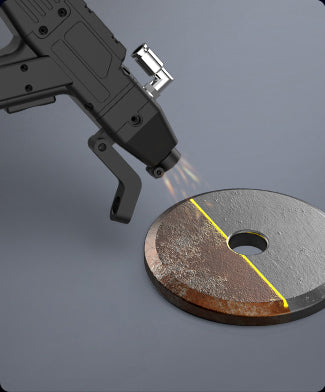
Handheld systems are the most versatile option for job shops, maintenance operations, and fabrication workshops. The operator holds a cleaning head — similar in form to a handheld welding head — and moves it across the workpiece surface. This allows treatment of large structures, irregular geometry, and areas that cannot be easily fixtured or moved to an automated system.
Many handheld systems combine laser cleaning with welding and cutting in a single unit. The GWEIKE LCW series, for example, allows the operator to switch between cleaning, welding, and cutting functions by changing the processing head — which means a single investment covers three common shop processes. This is particularly practical for fabricators who already use a handheld laser welder and want to add cleaning capability without separate equipment.
Automated Laser Cleaning Systems
For high-volume, repetitive cleaning tasks on standardized parts, automated systems with gantry or robotic motion deliver consistent results with minimal operator involvement. These are used in automotive manufacturing (pre-paint surface preparation on body panels), aerospace component cleaning, and production-line oxide removal between process steps.
Automated systems require more upfront investment in fixturing and programming but deliver better throughput consistency and eliminate operator-to-operator variation in results.
When handheld makes sense: Your parts are large or irregular, the work is done on-site or in the field, you have mixed cleaning tasks, or you want to add cleaning to an existing handheld welding workflow. When automated makes sense: You have a standard part family, high volume, and need consistent cycle time in a production line.
Safety note: Fiber laser cleaning systems operate as Class 4 lasers. Laser safety eyewear rated for the operating wavelength, adequate fume extraction, and trained operators are mandatory. Always follow the equipment manufacturer's safety instructions and applicable workplace safety regulations before use.
Applications by Industry
Steel Fabrication and Structural Work
Post-weld oxide removal is the most immediate application for fabricators already using laser welding. HAZ discoloration on stainless steel is removed in seconds per meter of weld — faster than wire brushing and without the risk of embedding abrasive particles. On carbon steel structural frames, laser cleaning removes weld spatter and surface rust before final paint, improving adhesion without requiring a separate blasting step.
Maintenance and Field Repair
Handheld laser cleaning is increasingly used for on-site maintenance: removing rust from equipment without disassembly, stripping paint from repair zones before welding, and cleaning electrical contact surfaces. The absence of abrasive waste is particularly valuable in food production, pharmaceutical, and other clean-environment settings where containment of abrasive media is a significant constraint.
Mould and Tool Maintenance
Injection moulds and die-casting dies accumulate carbon deposits, resin residue and release agent buildup that affect surface quality and part dimensions over time. Laser cleaning removes this fouling without touching the tool surface geometry or requiring disassembly, which reduces maintenance downtime and extends mould service intervals. This is one of the applications where laser cleaning has clearly displaced chemical cleaning in many facilities.
Automotive and Aerospace Components
Pre-weld and post-weld cleaning of automotive body components, battery housing parts, and aerospace structural assemblies benefits from the precision and speed of laser cleaning. In battery manufacturing, laser cleaning of electrode surfaces and tab areas before welding is used to remove oxide and contamination that would otherwise compromise weld quality and electrical resistance.
Precision Parts and Electronics
For small or dimensionally critical components — connectors, medical instruments, sensor housings — laser cleaning provides controlled surface treatment without the mechanical contact and dimensional uncertainty of abrasive methods. The process is dry, chemical-free, and can be targeted to specific zones with millimeter precision.
Which Laser Cleaning System Do You Need?
The right system depends on your primary task, part size, and whether you need cleaning alone or combined with welding. Use this table as a starting point.
| Your situation | Recommended direction | Power range |
|---|---|---|
| Post-weld HAZ cleaning, shop-floor weld finishing on stainless or carbon steel | LCW handheld 3-in-1 — cleaning, welding and cutting in one unit | 1000W–1500W |
| Rust removal, paint stripping, medium surface area per shift | LCW1500A handheld laser cleaning system | 1500W |
| High-volume cleaning, production line or batch processing | Automated or gantry-mounted cleaning system — contact us for configuration | 2000W–3000W |
| Mould cleaning, precision component surface treatment | Handheld system with fine scan control — 1000W–1500W covers most precision cleaning tasks | 1000W–1500W |
FAQ
Can laser cleaning replace sandblasting?
For many applications, yes. Laser cleaning is more precise, produces no abrasive waste, and does not change the surface profile of the base material. It is particularly effective for post-weld oxide removal, mould cleaning, and applications where dimensional tolerances must be maintained. For large-area rust removal on structural steel where surface roughness is needed for paint adhesion, sandblasting may still be more economical at scale.
What power laser do I need for rust removal?
For light surface rust and post-weld oxide on steel, 1000W is typically sufficient for handheld cleaning work. For heavier rust, larger surface areas, or higher production speed, 1500W to 3000W provides more practical throughput. Power requirement also depends on scan width, travel speed, and the depth of contamination. Always run a sample test on your specific substrate and contamination type before committing to production parameters.
Is laser cleaning safe for stainless steel?
Yes. Laser cleaning is widely used on stainless steel for post-weld discoloration removal and HAZ treatment. With correct parameters, the laser ablates the oxide layer and can restore the chromium oxide surface layer without chemical residue. In many standard fabrication applications, additional passivation is not required. However, for food-grade, pharmaceutical, medical or marine environments with strict corrosion resistance certification, verify passivation quality on your specific alloy and service environment before committing to production — particularly for alloys like 316L in demanding conditions.
What is the difference between laser cleaning and laser ablation?
Laser ablation is the broader physical term for removing material using laser energy. Laser cleaning is a specific industrial application of laser ablation where the goal is to remove surface contamination — rust, paint, oxides, coatings — while leaving the base material intact. In industrial contexts, the two terms are often used interchangeably when referring to surface decontamination processes.
Does laser cleaning require fume extraction?
Yes. Laser cleaning vaporizes and ablates surface contamination, releasing fumes and fine particles. Adequate fume extraction at the cleaning head is necessary for operator safety and to prevent redeposition of removed contamination on the clean surface. Most industrial laser cleaning systems include an integrated extraction nozzle on the cleaning head, and a shop-level filtration unit is recommended for sustained use.
Can the same machine do both laser cleaning and laser welding?
Yes, with a multi-function fiber laser system. The GWEIKE LCW series uses a single fiber laser source that can be configured for cleaning, welding, and cutting by changing the processing head and selecting the appropriate parameter set. This makes it practical for fabrication shops that need both welding and post-weld cleaning without investing in two separate machines.
Need Laser Cleaning, Welding and Cutting in One System?
The GWEIKE LCW series gives your workshop laser cleaning, welding and cutting capability in a single handheld unit — 1000W to 3000W. One machine, one operator, three capabilities.
Helpful to include when enquiring: material type, contamination type (rust / paint / oxide), estimated surface area per shift, and whether you need cleaning only or combined cleaning and welding.