Contents
Most people spend months choosing the right laser cutting machine. Then the machine arrives, and they discover they also need a large, heavy compressed air system — one that requires its own electrical supply and installation time. This guide covers everything you need to plan for before your machine arrives.
All specifications in this guide are based on DHH (Dehaha) screw compressor systems validated for use with fiber laser cutting machines. They represent recommended configurations, not minimum acceptable specifications. If you are unsure which option fits your situation, contact the GWEIKE team for a specific recommendation.
Why Air Quality Matters for Your Laser
When you cut with air assist, the compressed air does three jobs: it blows the molten material out of the cut, it cools the cut edge, and it protects the cutting lens from smoke and debris. If the air is dirty, wet, or has oil in it, all three jobs suffer — and you may not notice until the lens is already damaged.
The listed DHH treatment packages use the following reference targets:
- Particle size: ≤ 0.01 μm (that is one hundredth of a micron — invisible to the eye)
- Oil content: ≤ 0.003 PPM (essentially oil-free)
- Moisture: Dew point 2–10°C for standard cutting; -20 to -40°C for 10KW+ systems
A basic workshop compressor may not meet the required pressure, flow or air quality without suitable treatment. Confirm the required air-quality class, pressure-dew-point definition and measurement location with the cutting-head and machine documentation. Verify quality at the point of use after the dryer, filters, piping and regulator.
Why These Air-Cutting Configurations Use 16 Bar
Many factory pneumatic systems run at 6–8 bar, while the DHH packages listed here are rated for 16 bar continuous output. Whether an existing air system is sufficient depends on peak flow, pressure at the cutting head, pressure loss, material, thickness and nozzle configuration.
Enough for pneumatic tools and cylinders. Not enough to clear the kerf cleanly on a laser cutter or protect the optics at cutting speeds.
Adequate for thin material at low power. At 6KW and above, insufficient pressure causes dross buildup, oxidation on cut edges, and reduced lens life.
The compressor rating used by the configurations in this guide. It is not a universal cutting-head pressure for every material, thickness or machine.
All listed compressor packages are rated at 16 bar continuous output, while their nominal flow increases from 1.3 m³/min to 10.2 m³/min. Confirm the minimum pressure and flow available at the cutting head during peak demand because dryers, filters, regulators, valves and piping create pressure loss.
What's Inside a Laser-Grade Compressed Air System
A full laser cutting air system is not just a compressor — it is a chain of components that each do a different job. Understanding what each one does helps you know what you are buying and why you cannot skip any of them.

Screw air compressor
The heart of the system. A rotary screw type — not a piston type — is used because it delivers continuous high-pressure air without the pulsing that piston compressors produce. The motor size (15KW, 22KW, 37KW, etc.) determines how much air it can produce per minute.
Air receiver tank
A storage vessel that buffers the air supply. When the laser briefly demands more air than the compressor can instantly produce (during a burst cut), the tank supplies the extra volume. Bigger tanks mean more stable pressure during heavy cutting cycles. Size ranges from 350L to 2,000L in this guide.
Refrigerated air dryer
Cools the compressed air to 2–10°C, which causes moisture to condense and drain out. Every compressed air system in this guide includes one. It handles the bulk of moisture removal and is sufficient on its own for laser systems up to 8KW.
Desiccant dryer — 10KW+ only
Passes the air through a desiccant material (activated alumina) that absorbs moisture down to a dew point of -20 to -40°C — much drier than the refrigerated dryer alone can achieve. Required at 10KW and above, where higher air volumes and more sensitive optics demand drier air. Not present in systems for ≤8KW lasers.
Multi-stage precision filters
A series of filter elements — 5, 6, 7, or 9 stages depending on power level — that remove residual particles, oil aerosols, and vapors from the air. The filter chain is what achieves the ≤0.01μm particle and ≤0.003 PPM oil standard required at the cutting head. More stages are used at higher power levels because more air volume means more potential contamination.
Auto drain valves
Small automatic valves at the low points of the system that regularly discharge condensed water. Without them, water accumulates in the tank and piping, eventually bypassing the dryer and reaching the filters. They are included in every system in this guide and require no attention beyond periodic inspection.
Three System Tiers — Which One You Need
As laser power increases, the air system does not just get bigger — it changes in type. There are three meaningful tiers, and the jump from one to the next involves real changes in what equipment you need, not just larger numbers.
All-in-one integrated unit
- Format: Compressor, tank, refrigerated dryer and filters in one frame
- Footprint: Single unit, approx. 1.9×0.8×1.9m
- Weight: 500–650 kg
- Motor: 15KW or 22KW
- Dryer type: Refrigerated dryer only
- Filter stages: 5 or 6
- Installation: Plug in, connect to laser gas line — ready
Skid-mounted system with desiccant dryer
- Format: Separate compressor unit + skid-mounted rear section (dryers, filters, tank)
- Footprint: Two sections, more floor space required
- Weight: 750–1,050 kg
- Motor: 22KW
- Dryer type: Refrigerated + desiccant dryer ← new requirement
- Filter stages: 7
- Key change vs Tier 1: Desiccant dryer added for -20 to -40°C dew point
Large industrial split system
- Format: Standalone compressor + separate skid or split components
- Footprint: Significant floor area, often 4×2m or larger
- Weight: 1,200–2,200 kg
- Motor: 37KW–90KW
- Dryer type: Both refrigerated and desiccant
- Filter stages: 9
- Tank: Two tanks in parallel (1,200–2,000L total)
PM VFD vs Fixed Speed — Which to Choose
For each power tier, the selection table offers both a PM VFD (permanent magnet variable frequency drive) model and a fixed-speed model. The difference matters more than it might seem.
PM VFD (variable speed)
- How it works: The motor speeds up and slows down to match actual air demand
- Laser cutting fit: Excellent — laser machines use air in bursts (cutting, then pausing to pierce or load). VFD matches this pattern.
- Energy use: Significantly lower — compressor runs slow during idle, fast during cutting
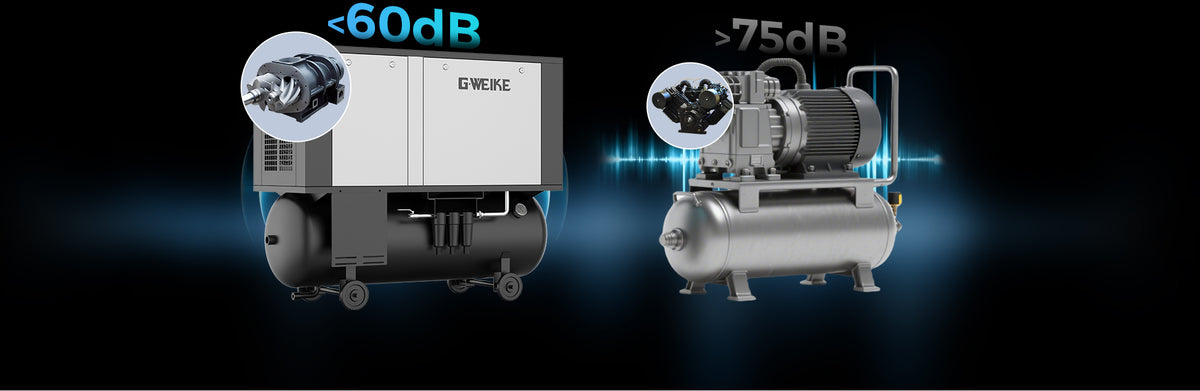
- Noise: Quieter, especially during pauses
- Upfront cost: Higher than fixed speed
- Payback: Calculate from the price premium, measured loaded/unloaded power, annual operating hours, average air demand and local electricity tariff
- Recommended for: Most laser cutting shops running 4+ hours per day
Fixed speed
- How it works: Motor runs at full speed continuously, regardless of demand
- Laser cutting fit: Adequate — but wastes energy when the laser is not actively cutting
- Energy use: Higher — full-speed operation even during idle periods
- Noise: Louder, constant
- Upfront cost: Lower than PM VFD
- Payback: Lower upfront, but higher operating cost over time
- Recommended for: Very low usage (less than 2 hours per day) or tight initial budget
Complete Selection Table
The table below shows DHH planning configurations by laser power. All listed packages are rated at 16 bar; final flow, tank and treatment selection must be checked against actual peak demand and site conditions.
Confirm these eight inputs before selecting a package
- Materials and thicknesses that will actually use air assist
- Peak cutting-head pressure and flow from the machine supplier
- Nozzle type and diameter
- Expected cutting duty cycle
- Dryer, filter, regulator and piping pressure loss
- Any other equipment sharing the air system
- Site altitude and ambient temperature
- Required flow reserve and receiver-tank response
As an early planning check, many projects reserve approximately 15–25% flow above calculated peak demand, but the final margin must be approved by the machine and compressor suppliers.
Use the fiber laser installation checklist to coordinate floor space, electrical capacity, ventilation and utility connections.
↔ Swipe to view full table
| Laser power | Air flow (m³/min) | Tank volume | Filter stages | Desiccant dryer | Compressor motor | PM VFD model | Fixed speed model |
|---|---|---|---|---|---|---|---|
| Tier 1 — All-in-one integrated unit | |||||||
| ≤4KW | 1.3 | 350L | 5-stage | No | 15KW | CPMZY15 | — |
| ≤6KW | 1.5 | 500L | 5-stage | No | 15KW | DMZY20 | DBZY20 |
| 6–8KW | 2.0–2.41 | 400–500L | 5–6 stage | No | 22KW | CPMZY22 / DMZY30A | DCZY30A |
| Tier 2 — Skid-mounted system + desiccant dryer | |||||||
| 10–15KW | 2.41 | 600L | 7-stage | Yes — -20 to -40°C | 22KW | CPM30AAS / DM30AAS | DC30AAS |
| Tier 3 — Large industrial split system | |||||||
| 20–30KW | 3.9 | 1,200L (2×600L) | 9-stage | Yes — -20 to -40°C | 37KW | CPM50AAS / DM50AAS | — |
| 40KW | 6.2 | 2,000L (2×1,000L) | 9-stage | Yes — -20 to -40°C | 55KW | DM75AAS | — |
| 60KW | 9.0 | 2,000L (2×1,000L) | 9-stage | Yes — -20 to -40°C | 75KW | DM100AAS | — |
| 80KW | 10.2 | 2,000L (2×1,000L) | 9-stage | Yes — -20 to -40°C | 90KW | DM125AAS | — |
DHH package references: rated output 16 bar, particle target ≤0.01 μm and oil target ≤0.003 PPM. Confirm air quality at the required measurement point and verify current model availability, performance and pricing before ordering.
Electrical Requirements — Plan This Before the Machines Arrive
This is the section most buyers overlook until it is too late. The air compressor needs its own dedicated electrical circuit — it cannot share a supply with the laser machine. At higher power levels, the cable and breaker requirements are substantial. Getting an electrician in to run this wiring after the machines are already on site adds weeks to your installation timeline.
↔ Swipe to view full table
| Laser power | Compressor motor | Supply cable (compressor) | Supply cable (dryer) | Circuit breaker | Notes |
|---|---|---|---|---|---|
| ≤4KW | 15KW | 10 mm² | 2.5 mm² | 60A | Standard installation |
| ≤6KW | 15KW | 10 mm² | 2.5 mm² | 60A | Standard installation |
| 6–8KW | 22KW | 16 mm² | 2.5 mm² | 80A | Heavier cable than ≤6KW |
| 10–15KW | 22KW | 16 mm² | 2.5 mm² | 80A | Separate circuit for desiccant dryer |
| 20–30KW | 37KW | 25 mm² | 2.5 mm² | 120A | Consult electrician for cable run length |
| 40KW | 55KW | 50 mm² | 2.5 mm² | 160A | Large cable — plan conduit route in advance |
| 60KW | 75KW | 70 mm² | 2.5 mm² | 250A | May require panel upgrade — check with utility |
| 80KW | 90KW | 95 mm² | 2.5 mm² | 250A | May require panel upgrade — check with utility |
Cable values are DHH package planning references. Confirm both compressor and dryer nameplate current; do not apply one conductor size to every dryer or destination. Final sizing must account for cable length, voltage, starting method, installation conditions and local regulations.
Maintenance Schedule
A screw air compressor for laser cutting is a production machine whose condition affects air quality and cut stability. The intervals below are DHH/Dehaha reference intervals. Follow the manual supplied with the exact compressor, dryer and filter system; severe dust, heat, humidity or continuous operation may require shorter intervals.
First service
500 hours or 3 months (whichever comes first)- Air filter element
- Oil filter
- Lubricating oil (full change)
New machines accumulate more debris in the first few hundred hours. The first service clears this and establishes a clean baseline.
Regular service
2,500 hours or 6 months (whichever comes first)- Air filter element
- Oil filter
- Oil separator core
- Lubricating oil (full change)
Annual service
5,000 hours or 12 months (whichever comes first)- Air filter element
- Oil filter
- Oil separator core
- Lubricating oil (full change)
- All precision filter elements
- Desiccant adsorbent (if fitted)
- Drive belts (belt-drive models)
Not sure which system fits your setup?
Tell us your laser machine's power level, your facility's current electrical capacity, and your daily production hours. We can confirm the right compressor system and check whether any electrical upgrades are needed before your machine arrives.
Helpful to include: laser machine model and power (KW), factory voltage (single or three phase, 220V/380V/440V), approximate distance from main panel to machine area, and whether compressed air is currently available on site.
FAQ
Can I use my existing factory air supply (6–8 bar) for laser cutting?
A 6–8 bar factory line may be insufficient for many production air-cutting processes, but the requirement is machine- and process-specific. The DHH packages in this guide are rated for 16 bar. Confirm peak flow, system pressure loss and required cutting-head pressure before deciding whether an existing air system can be used.
Why does a 10KW laser need a desiccant dryer when a 8KW doesn't?
The listed DHH configurations add a desiccant dryer from 10 kW to achieve a lower pressure dew point at higher flow. This is a package-design threshold, not a universal laser-power rule. Confirm the required pressure dew point and air-treatment configuration with the cutting-head and compressor documentation.
What is the difference between a PM VFD compressor and a fixed-speed compressor?
A PM VFD compressor adjusts motor speed to air demand, while a fixed-speed compressor has less ability to follow variable demand. Calculate payback from the price premium, measured power at expected load, annual operating hours and local electricity tariff rather than assuming a fixed 12–24 month period.
Does the air compressor need its own electrical circuit?
Yes. The compressor motor draws significant current — from 60A for a 15KW unit up to 250A for a 90KW unit. Running it on the same circuit as the laser machine causes voltage drops and tripped breakers. The compressor always needs a dedicated circuit with the correct cable and breaker rating. See the electrical specifications table in Section 7. Plan this wiring before the machines arrive — it is one of the most common causes of installation delays.
How often does the air compressor need servicing?
The listed DHH reference schedule starts at 500 hours or 3 months, followed by 2,500-hour/6-month and 5,000-hour/12-month reference intervals. Follow the exact compressor, dryer and filter manuals because operating conditions may require shorter service periods.