

Rule of thumb
Choose 3015 for mixed job-shop work and best overall value. Move to 6025/8025 when you cut long parts or want fewer sheet changeovers. Pick 4020 when you need “bigger than 3015” without jumping to 6025.
| Bed size | Best for | Why it wins | Watch-outs | Next step |
|---|---|---|---|---|
| 3015 | Most sheet-metal shops, mixed orders | Best value, easiest handling, lowest footprint | Long parts may need repositioning | See 3015 options |
| 4020 | Occasional larger sheets / parts | Middle ground: flexibility with moderate footprint increase | Still not ideal for very long parts | See 4020 options |
| 6025 | Long parts, higher throughput | Fewer changeovers, better long-part productivity | Needs stronger handling workflow (forklift/crane/automation) | See 6025 options |
| 8025 | Ultra-long parts, fewer seams | One-shot long-part cutting; fewer joints and rework | Largest footprint + material logistics planning required | See 8025 options |
For flat sheet production, bed size should match your material format and production volume. Compare available sheet metal laser cutting machines. Bed size is only one part of the complete configuration; use the sheet metal laser cutting machine selection guide to compare power, automation, material handling and installation requirements together.
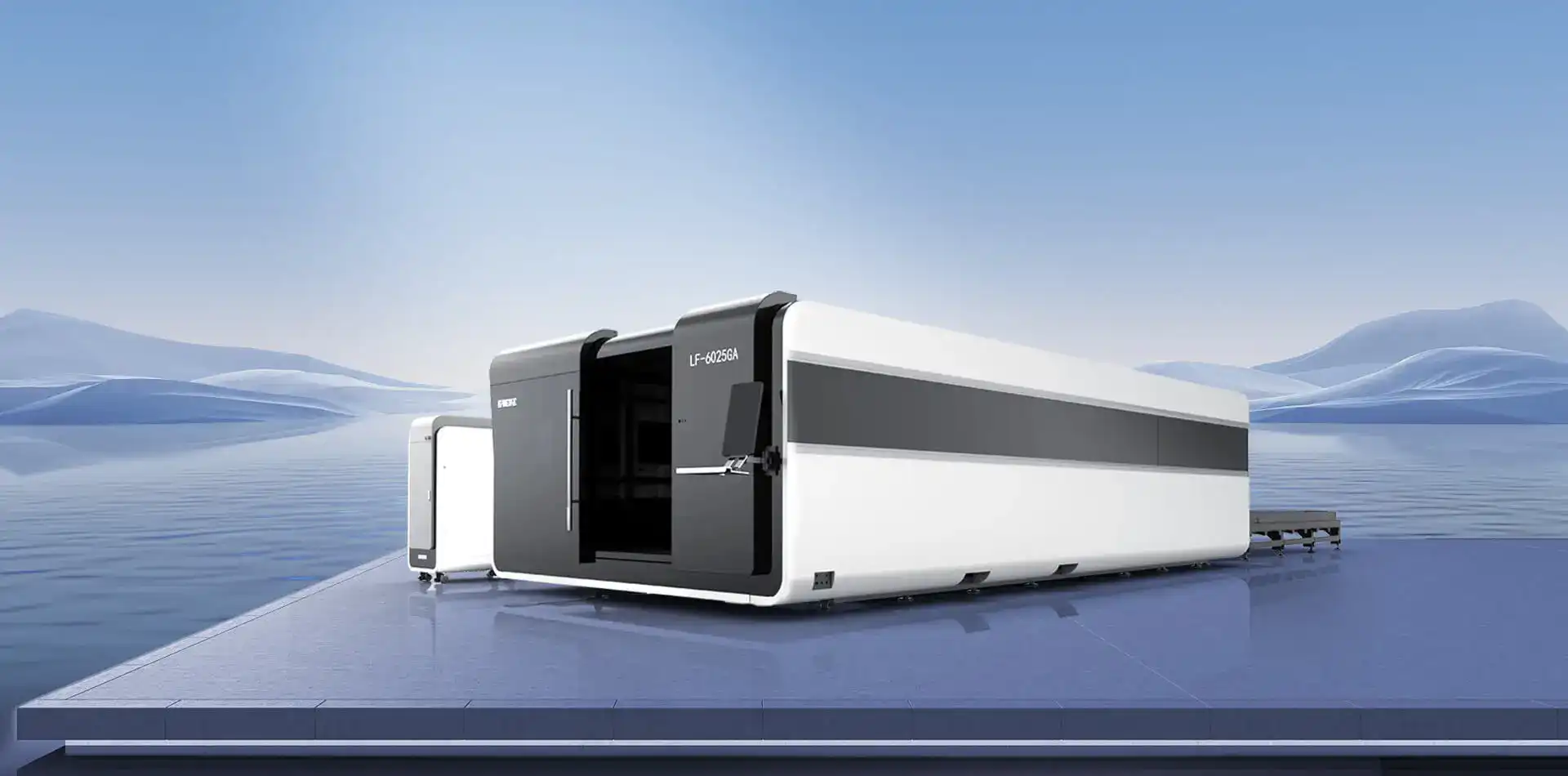
What bed size really changes (beyond “how big a sheet fits”)
Bed size selection impacts much more than maximum sheet dimensions. It directly affects:
- Part length capability: whether long parts can be cut in one setup or require repositioning.
- Changeover frequency: larger beds can reduce sheet swapping (especially on exchange-table systems).
- Material handling requirements: sheet weight and size determine whether a simple cart works—or you need forklift/crane/vacuum lifter.
- Floor space and logistics lanes: clearances for loading/unloading, scrap removal, and safe operator routes.
- Automation readiness: large-format beds typically benefit more from automatic loading/unloading or a material tower.
If you choose a bed that’s too large for your handling workflow, the machine can become “fast but waiting”—your real bottleneck shifts to loading/unloading.
Fast size selector (answer these 6 questions)
- What sheet sizes do you use most often? (e.g., common formats like 4×8, 5×10, 6×12, or custom)
- What is your max part length? (the longest finished part you cut regularly)
- How many sheet changeovers happen per shift? (if changeovers are frequent, a larger bed or automation may pay back)
- What handling equipment do you have? (forklift, overhead crane, vacuum lifter, or none)
- How much floor space is truly available? (include clearance for carts, forklifts, and safe walking lanes)
- Order mix: mostly small parts (high nesting) or mostly large frames/long parts?
Decision rules:
- If max part length is regularly > ~3 m, prioritize 6025 or 8025.
- If you run mixed orders and want the best value, start with 3015.
- If you need “a bit bigger than 3015” but don’t want the footprint jump, consider 4020.
- If changeovers are the bottleneck and you already have strong handling workflow, 6025 tends to deliver faster ROI.
3015 bed size: best all-round choice for most sheet-metal shops
A 3015 bed is often the safest decision when you have mixed job-shop work, limited space, and you want the best balance of capex, throughput, and handling simplicity.
If your main application is stainless steel, carbon steel or aluminum sheet production, choose between 3015, 4020 and larger formats using your normal sheet dimensions, part length and handling workflow.
4020 bed size: a practical middle ground when you need more than 3015
4020 makes sense when you occasionally cut larger sheets or parts and want extra flexibility without moving all the way up to 6025.
6025 bed size: higher throughput, fewer changeovers, better for long parts
6025 is a strong upgrade when your shop runs higher volume, cuts longer parts, or wants to reduce time lost to loading/unloading and sheet swapping.
For 6025, 8025 and other large-format configurations, compare GWEIKE fiber laser cutting machines by bed size, laser power, exchange table and material handling requirements.
8025 bed size: ultra-long parts and fewer seams
8025 is ideal when ultra-long parts are central to your production and you want to avoid seams, extra welding, and repositioning. It’s typically justified by specific product geometry and throughput goals.
3015 vs 6025: which size delivers better ROI?
This is the most common decision. Here’s a clear comparison across the factors that typically drive ROI.
| Decision factor | 3015 | 6025 |
|---|---|---|
| Best use case | Mixed orders, general fabrication | Long parts, higher throughput, fewer changeovers |
| Material handling | Easier for most shops; simpler workflow | Benefits from forklift/crane/vacuum lifter or automation |
| Floor space & logistics | Lower footprint; easier lane planning | Larger footprint; needs clear lanes for loading/unloading |
| Typical ROI driver | Lower capex + flexibility | Less downtime on loading/unloading + long-part efficiency |
| When it loses | When long parts dominate or changeovers are constant | When handling workflow is weak (machine waits for sheets) |
Rule of thumb:
If your longest parts regularly exceed ~3 m, or your operators spend too much time waiting on sheet changeovers, prioritize 6025. Otherwise, 3015 is usually the best value.
Floor space & material handling (the hidden success factor)
Larger beds can increase productivity—if your handling workflow keeps up. Before choosing 6025/8025, confirm:
- Loading method: forklift/crane/vacuum lifter vs manual carts.
- Clearances: space for loading/unloading, scrap removal, and safe operator movement.
- Staging area: where raw sheets wait, where finished parts go, and where skeleton scrap is placed.
- Future automation: if you plan a material tower or auto loading, size selection should anticipate it.
If you upgrade bed size but keep the same slow handling process, the machine becomes underutilized. Many shops see bigger gains by pairing 6025 with better logistics than by power upgrades alone.
Bed size and laser power should be selected together because a larger bed changes part flow and machine utilization. Use the fiber laser cutting power selection guide to match throughput requirements with the appropriate power tier.
Before ordering a 4020, 6025 or 8025 system, confirm loading clearance, electrical capacity, gas delivery, extraction and service access using the fiber laser cutter installation requirements checklist.
If your factory needs both flat sheet and moderate-volume tube cutting, compare the footprint of two dedicated machines with one sheet and tube laser cutting machine . Include the tube loading length, chuck area, maintenance access and material handling route—not only the nominal sheet bed size.
Nesting, utilization & ROI: when bigger is (and isn’t) better
When a larger bed improves ROI
- Long parts: one setup, fewer seams, less repositioning and rework.
- Frequent changeovers: fewer swaps can increase “effective cutting time.”
- Production scheduling: larger sheets can simplify batching and reduce idle time.
When a larger bed may reduce ROI
- Handling bottlenecks: slow loading/unloading cancels the productivity advantage.
- Inventory constraints: if large-format sheets are harder to source consistently.
- Space constraints: compromised safety lanes or messy logistics create downtime.
A larger bed affects not only the machine price but also freight, site preparation, material handling and automation cost. Review the fiber laser cutting machine price guide before comparing configurations by purchase price alone.
Next step
How to confirm your size before buying (fast and accurate)
The fastest way to confirm bed size is to use your real production data. Prepare a short “cut list” containing:
- Top 10 part drawings (or max part length/width)
- Typical sheet sizes and thickness ranges
- Target edge quality (deburr tolerance / cosmetic requirements)
- Current bottleneck (changeovers, handling, quality, or throughput)
- Available floor space and handling equipment
Want a confirmed bed size recommendation for your shop?
Share your sheet sizes, max part length, and daily changeover frequency. We’ll recommend the best GA Series bed size and a practical configuration path.
FAQ
What do “3015/4020/6025/8025” mean?
They refer to the approximate cutting bed size class (commonly used to describe working area format). The right choice depends on your sheet sizes, max part length, handling workflow, and floor space.
What’s the best bed size for a job shop with mixed orders?
For most mixed-order shops, 3015 is the best value because it’s flexible, easier to handle, and typically fits limited floor space. Upgrade when long parts or changeovers dominate your production time.
Is 6025 faster than 3015?
The cutting speed depends on power, process, and material—but 6025 often improves throughput by reducing sheet changeovers and enabling long parts in one setup. ROI depends on your handling workflow.
When should I choose 4020 instead of 3015?
Choose 4020 if you occasionally need larger sheets or parts and want extra flexibility, but you are not ready for the footprint and logistics planning required for 6025.
Do I need automatic loading for 6025/8025?
Not always, but larger beds benefit more from stronger handling workflows. If your operators spend significant time loading/unloading, automation (or at least better lifting tools) can be a major ROI driver.
Can I cut long parts on a smaller bed by repositioning?
It’s possible in some workflows, but repositioning adds time, increases alignment risk, and can introduce quality variation. If long parts are a daily requirement, 6025/8025 is usually a cleaner solution.
How do I confirm the right size before purchasing?
Use a real cut list: your typical sheet sizes, max part length, thickness range, target edge quality, and shift changeover frequency. With that, size selection becomes straightforward and defensible.