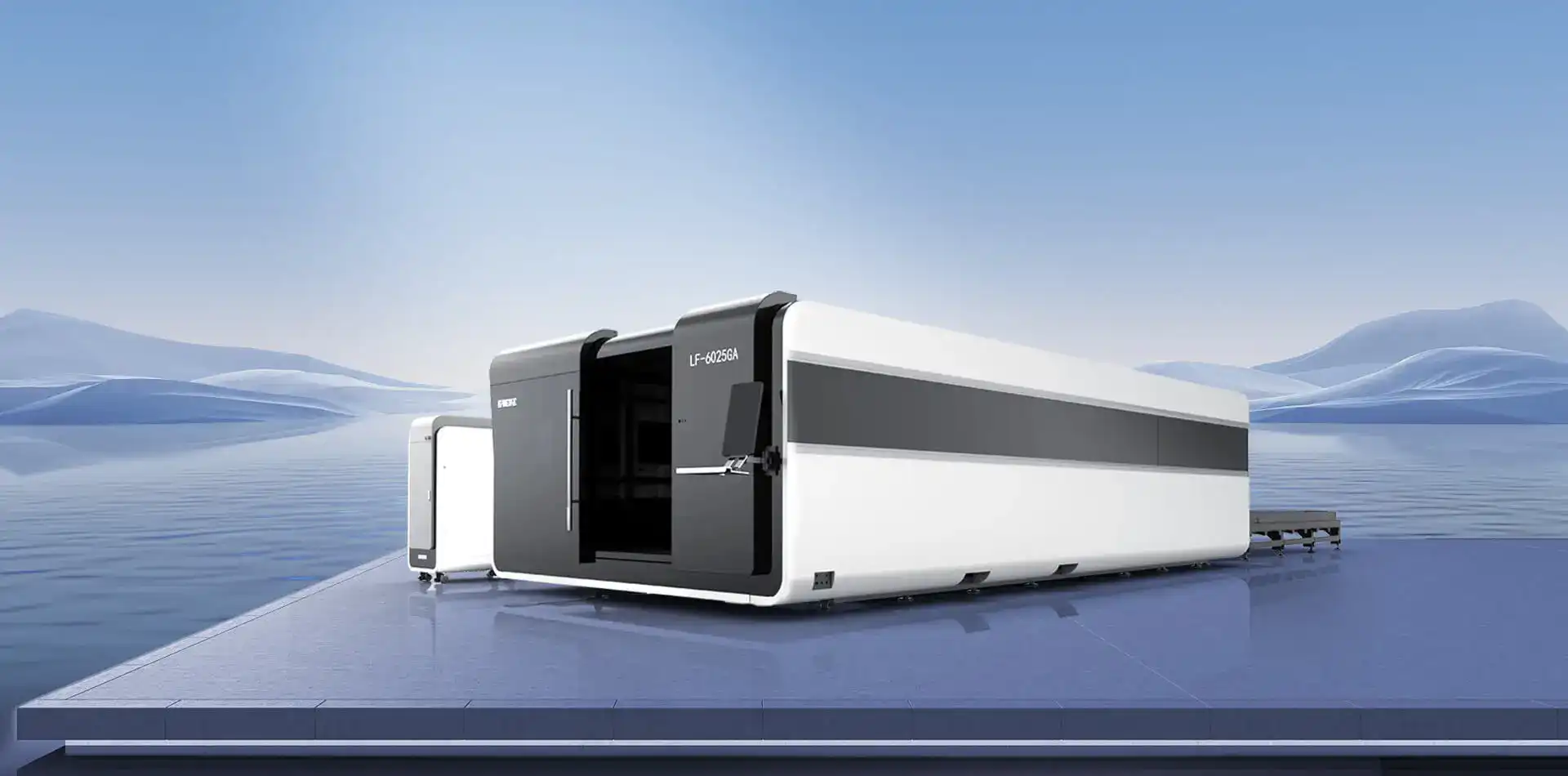
GA Series Enclosed Exchange Table Fiber Laser Cutting Machines
GA Series is designed for high-efficiency sheet metal production with an enclosed protective cabin and an automatic exchange table.
It targets professional metal processing scenarios such as sheet metal fabrication, hardware products, precision machinery, and automotive parts.
Watch the GA Series enclosed exchange table fiber laser cutting machine in action.
GA Series positioning
GA Series is an enclosed exchange-table fiber laser cutting platform for industrial sheet metal processing.
The system architecture typically integrates a fiber laser source, laser cutting head, CNC control system, servo drives,
linear guideways, rack & pinion transmission, and a welded machine bed—engineered for production stability.
Typical industries
Sheet metal fabrication, metal crafts, hardware products, precision machinery, automotive parts, general metal processing
workshops that require both throughput and safety compliance.
Why enclosed + exchange table matters
Enclosure improves operator protection and workshop cleanliness; pallet exchange separates “cutting time” from “loading time”
so the machine spends more hours producing parts rather than waiting for handling.
For more enclosed and exchange-table options, compare GWEIKE sheet metal laser cutting machines
for different power levels, bed sizes, enclosure types, and production needs.
Enclosed safety cabinExchange tableIndustrial stabilityMultiple bed sizesO₂ / N₂ / air cutting
GA model comparison table
Use this table to shortlist by sheet size, factory layout, and productivity target. If you routinely cut thick carbon steel,
prioritize higher power; if you need clean stainless edges, prioritize nitrogen capacity + stable gas supply.
Note on working area naming: in industrial fiber laser cutters, model codes commonly map to cutting area
(e.g., 3015 ≈ 3000×1500 mm). Confirm final stroke with your quotation sheet.
Very large sheets and long-part production; automotive/engineering large panels; maximum nesting freedom.
Suggested next step: decide the largest sheet you need to run, then pick power by your
thickness range + target takt time.
How to choose a GA model
Step 1 — choose bed size by sheet & part geometry
Pick the model that fits your dominant plate size and your largest part.
If you often cut long parts (frames/rails), 6015/6020 can reduce re-positioning and improve nesting yield.
Step 2 — choose power by thickness & productivity
Higher power is not only “thicker cutting”; it also raises throughput on common thicknesses.
If your workload is mostly thin stainless with clean edges, focus on stable N₂ supply and gas pressure capability.
Step 3 — match gas strategy to quality requirement
O₂ for faster carbon steel with oxidation; N₂ for stainless/aluminum clean edges.
GA supports multi-gas selection; define your edge-quality target first.
Ensure 3-phase power capacity, stable voltage (stabilizer sizing), chiller water volume,
dust extraction, and enough clearance for pallet exchange and maintenance access.
If you share your material list + thickness range + monthly tonnage, we can map it to a
practical configuration (power, cutting head option, gas supply plan, and recommended accessories).
Site prep & installation notes
GA Series requires a clean, well-ventilated workshop with reliable dust extraction and safe gas handling.
Plan access routes for delivery, lifting, and future maintenance.
Ventilation & dust extraction: ensure the cutting cabin is connected to an effective dust removal system; keep the workshop air clean and stable.
Clearance planning: keep service space around the machine for electrical cabinet access, chiller service, and exchange table movement.
Lifting & rigging: for large formats (notably 6025/8025 class), plan heavier lifting capacity during installation (manual mentions 15-ton lifting equipment requirement for large models).
Safety compliance: fiber laser is Class IV; ensure trained personnel, proper protective eyewear, and safe operating procedures.
Practical checklist before installation
Floor bearing capacity verified · 3-phase power ready · gas lines & regulators installed · chiller space + drainage arranged · exhaust duct route planned · training slot reserved
Utilities: power / gas / cooling (operation prerequisites)
Stable utilities are critical to cutting consistency and uptime. Below are series-level baseline requirements
commonly stated in GA manuals; final values should follow your quotation sheet for the selected laser power.
Power (3-phase)
Typical industrial 3-phase supply is required. Voltage stabilizer is recommended to protect laser source and electronics.
Common stabilizer sizing reference: 30 kVA (1–4 kW) and 50 kVA (6 kW) class.
Assist gas
Oxygen purity commonly specified around 99.6%; nitrogen around 99.99%.
Nitrogen regulator output can be configured up to 3.0 MPa for high-quality stainless cutting.
Cooling water
Use clean distilled/purified water. Typical fill volumes reference: 15 L (1–1.5 kW), 25 L (2–3 kW), 50 L (4–6 kW).
Keep water temperature within a stable operating range (often 18–28°C class).
Operation & maintenance highlights
GA Series reliability depends on disciplined daily checks: optics cleanliness, gas supply stability, chiller parameters,
lubrication schedule, and dust extraction performance.
When edge quality varies: verify focus, nozzle alignment, assist gas pressure stability, and material batch differences.
Tune speed first before changing multiple parameters.
FAQ
What materials is GA Series typically used for?
GA Series is positioned for industrial sheet metal processing, commonly including carbon steel, stainless steel,
aluminum alloys, and other metal sheets used in hardware, machinery parts, and automotive components.
Final capability depends on power configuration and process setup.
Which gas should I use—oxygen or nitrogen?
Oxygen is commonly used for carbon steel when speed and cost are priorities (oxidized edge is expected).
Nitrogen is commonly used for stainless/aluminum to achieve cleaner, oxide-free edges. GA supports multi-gas selection;
define your edge-quality requirement first, then match pressure and purity supply.
What should I prepare in the workshop before delivery?
Confirm 3-phase power capacity, recommended stabilizer sizing, chiller placement and drainage, assist gas lines
with proper regulators, a dust extraction route, and enough clearance for the exchange table and maintenance access.
Also plan lifting equipment for installation—large-format models require heavier lifting capacity.
Is enclosure enough for safety?
Enclosure improves protection, but fiber lasers are Class IV systems. Proper training, safe operating procedures,
interlocks, eyewear selection, and workshop controls are still required.
Want a confirmed configuration for your exact materials and thickness range?
Send your material list, thickness range, and edge-quality requirement. We’ll recommend a practical GA configuration
(bed size + laser power + gas plan) and provide a quotation and cut-test recommendation.
Looking beyond GA? Here are other GWEIKE cutting platforms from our Fiber Laser and CO₂ lines—covering high-power plate cutting, auto loading, sheet & tube, and non-metal CO₂ applications. For more flat metal production options, compare our sheet metal laser cutting machines.
Fiber Laser Cutting Machines
GH Series (Ultra-high Power, Large Format)
Thick plate / high power
Flagship large-format platform for high-power sheet metal cutting and heavy-duty production.
Large formatHigh power optionsIndustrial production
Want a fast recommendation? Share your material list, thickness range, and production volume. We’ll suggest the right platform and a practical configuration path.