

What this guide helps you decide
- Which GA model size fits your orders (3015 / 4020 / 6015 / 6020 / 6025 / 8025)
- How to choose kW based on thickness mix, quality target, and productivity
- Which options matter most for repeatable quality and uptime
- Factory readiness checklist (power, gas, ventilation, foundation, clearance)
- Acceptance criteria and ramp plan for stable production
- Where exchange-table productivity delivers ROI (and where it doesn’t)
GA Series model scope (sizes you can standardize on)
GA series exchange-table fiber laser cutting machines are commonly used in sheet metal processing, hardware products, precision machinery and auto parts production environments.
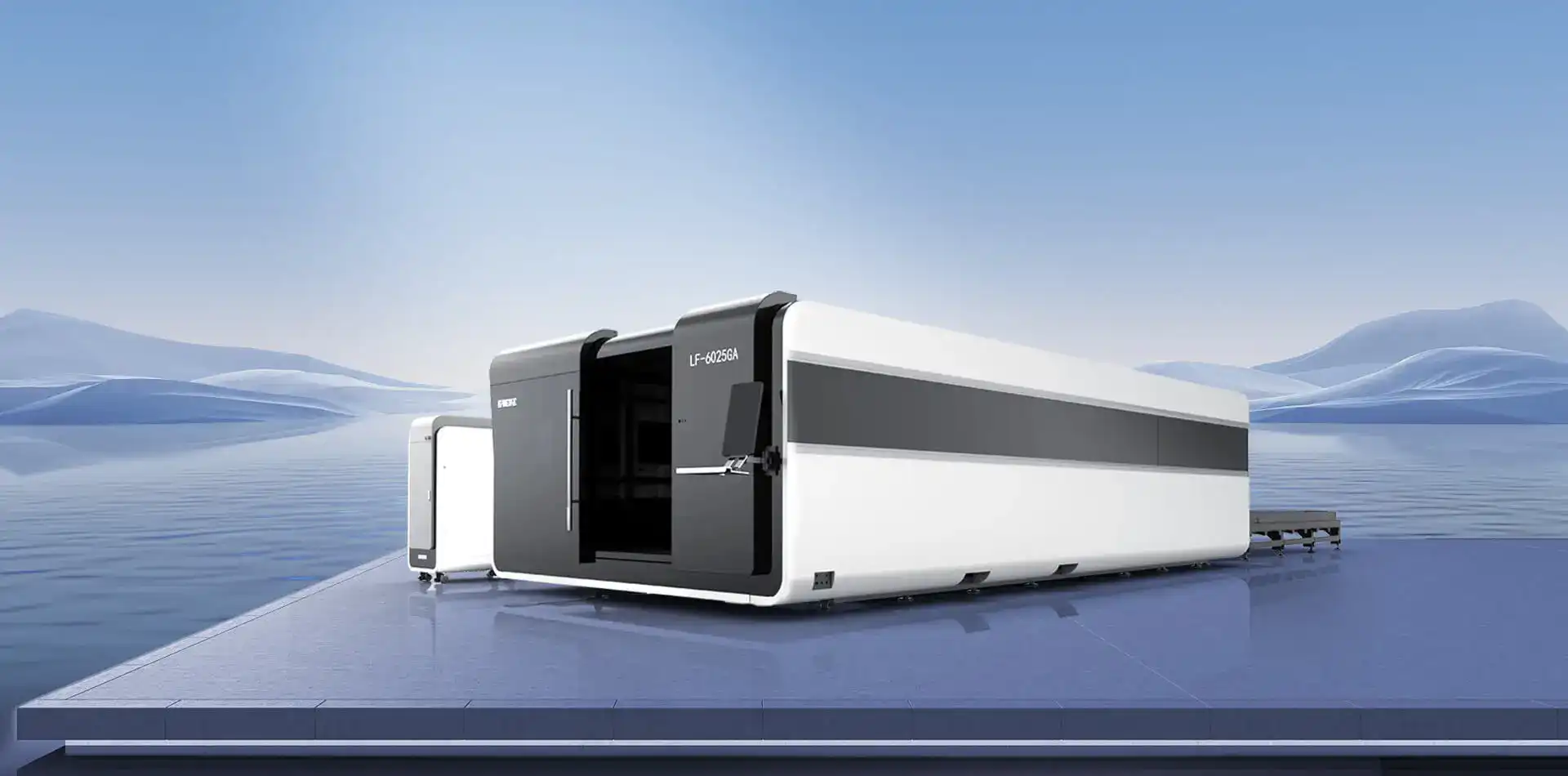
In the GA manual, the foundation and external dimension drawings are provided for these standard models, which makes it easier to plan factory layout and installation in advance: LF3015GA, LF4020GA, LF6015GA, LF6020GA, LF6025GA, LF8025GA.
| Model | Typical sheet class | Best fit | What to validate | Product link |
|---|---|---|---|---|
| LF3015GA | 3015 | Most job shops and standard sheet workflows; high utilization with smaller footprint | Max sheet size, staging space, changeover frequency (exchange-table ROI) | View LF3015GA |
| LF4020GA | 4020 | Oversized sheets, larger nests, fewer remnant issues | Material logistics: forklift path, offload area, nesting efficiency gains | View LF4020GA |
| LF6015GA | 6015 | High throughput lines; long-part production; batching to reduce changeover | Floor loading, utility capacity, ventilation/ducting sizing | View LF6015GA |
| LF6020GA | 6020 | Large-format sheets with stable order patterns | Handling tools and staging; scrap/remnant management | View LF6020GA |
| LF6025GA | 6025 | Large-format industrial sheet, heavy production environments | Foundation and lifting plan; power & gas provisioning | View LF6025GA |
| LF30155GA | 3015 | Maximum nesting area and fewer sheet swaps for long runs | Plant access, crane capacity, floor plan and vibration mitigation | View LF3015GA |
The GA Series is one option within GWEIKE's sheet metal laser cutting machine range for enclosed, exchange-table metal sheet production. If you are comparing open-type, enclosed, high-power and large-format flat-bed systems, review the full sheet metal laser cutting machines category before selecting a GA configuration.
Want a confirmed “cut list” configuration for your exact materials?
Share your material grade, thickness range and edge-quality requirement. We’ll recommend the right GA size + kW + options, then validate with sample cutting if needed.
The GA selection framework (5 steps)
The most reliable way to select a fiber laser cutter is to treat it as a production system, not a single machine. That means you lock (1) the materials and thickness mix, (2) throughput targets, (3) edge-quality standard, and (4) your factory utilities and workflow constraints.
Video: GA Series configuration walkthrough
Watch the key configuration logic and factory readiness checks in one place.
Write down the thickness range you actually quote weekly, the thickest jobs you want to win, and your quality requirement (dross tolerance, oxide tolerance, bend-ready edges, visible decorative edges, etc.). This defines your realistic kW band.
Select the smallest bed that fits 80–90% of orders to maximize utilization, then validate staging space, forklift/crane access, and remnant handling.
Exchange tables help most when sheet changeovers are frequent. Automation adds another step function, but only if your order mix supports it.
Prioritize options that reduce scrap and downtime: stable gas delivery, reliable extraction/ventilation, collision protection, and maintainability.
Foundation, clearance, stable power, proper grounding, clean dry air, and ventilation should be confirmed before delivery to compress time-to-production.
Step 1: How to choose laser power (kW) without overspending
A high-power laser can improve speed and extend thickness capacity, but it also increases capex and can raise operating costs. The goal is not “maximum kW”—it is “best kW for your profitable cut list.”
A practical rule
Choose kW based on your thickness mix + edge-quality requirement + throughput target. Then verify the decision with test cuts on your real material grades. (Material grade, surface condition, and gas strategy can shift results.)
| Decision input | What to record | How it affects kW selection | Where GA config changes |
|---|---|---|---|
| Max profitable thickness | Top 5 thickest recurring parts you want to win | Sets the minimum kW band you can’t go below | Laser power band, gas strategy, piercing method |
| Quality target | Bend-ready? Cosmetic edge? Low oxide? | May push you to nitrogen strategy and tighter parameter window | Nozzle selection, focus strategy, gas stability, extraction |
| Throughput goal | Parts/day or sheets/day, shifts, peak demand | Higher throughput can justify higher kW and exchange-table workflow | Exchange table, nesting strategy, automation layer |
| Material mix | CS/SS/Al ratio, reflective materials | Reflective materials emphasize process stability and protection strategy | Cut head protection, gas purity, parameter library |
Gas strategy matters for both quality and cost
Cutting gas pressure and selection directly affect cut quality and productivity—too low can reduce speed and penetration, too high can worsen roughness and kerf behavior. For stainless with nitrogen, higher thickness typically demands higher pressure (often high-pressure operation).
Step 2: Choose GA bed size by workflow (not only sheet size)
Bed size decisions are often made too late—after purchase—when the factory layout is already constrained. The GA manual provides workshop size preparation guidance and foundation/external dimension drawings by model, which you should use to plan clearance, access, and safe staging areas before delivery.
- Forklift/crane approach path and turning radius
- Sheet staging space (incoming + outgoing) near the exchange table
- Maintenance access zones (rear/side clearance)
- Ducting route for dust extraction (avoid long sharp turns)
- Choosing oversized bed without space for staging (creates bottlenecks)
- Underestimating ducting and chiller placement space
- Ignoring floor loading and flatness requirements
- No plan for remnant (leftover sheet) storage and tracking
Step 3: Select the productivity layer (3 configuration packages)
GA exchange-table platforms excel when your operation is limited by load/unload time and changeover frequency. To make it easy to buy and deploy, you can position the GA series in three practical packages.
Best for job shops with mixed orders and budget discipline.
- Right-sized GA bed (utilization first)
- Standard nesting workflow + parameter library baseline
- Dust extraction sized to your material mix
Best ROI lever Reduce waiting time with exchange-table scheduling discipline.
Best for repeatable orders, 2-shift operations, and stable demand.
- Material staging carts / pallet discipline
- Optional assisted loading/unloading workflow
- Quality stability options prioritized (gas + head protection + maintenance tooling)
Best ROI lever More effective cutting hours per shift without adding headcount.
Best for high-volume production and lights-out ambitions.
- Automation-ready layout and utilities planning
- Remnant management workflow and traceability
- Stable parameter governance and acceptance criteria
Important Automation ROI depends heavily on order stability and consistent material supply.
- High changeover frequency → prioritize exchange-table discipline and staging
- Stable high volume → semi/automation can pay back faster
- Quality-critical parts → invest in stability (gas, extraction, maintenance process)
If you want, we can map your cut list to one of these packages in a single call.
Step 4: Options that actually improve stability (quality + uptime)
Avoid option overload. In real factories, only a small set of decisions materially change your scrap rate and uptime: stable utilities, controllable process, and maintainability.
| Priority | Option area | What it improves | How to validate |
|---|---|---|---|
| P1 | Gas delivery stability & purity | Edge quality, piercing success rate, consistent speed | Trial cuts across thickness range; check dross and pierce reliability |
| P1 | Extraction/ventilation sizing | Operator safety, lens life, stable cutting environment | Confirm airflow, ducting route, and maintenance plan |
| P2 | Cutting head protection & collision strategy | Lower crash risk; fewer consumable events; faster recovery | Observe pierce behavior; validate head follow and protection behavior |
| P2 | Parameter governance (library + test protocol) | Repeatability across shifts; fewer “tribal” settings | Build a baseline matrix and lock versioning after test cuts |
| P3 | Automation expansions | Throughput and labor efficiency | Validate order stability and material supply reliability first |
Safety and environment are non-negotiable
Fiber laser cutting is Class IV and requires proper protection and ventilation; exhaust gas is harmful and the site should be ventilated with dust suction operating normally. The operator should wear laser protective lenses (1064 μm) and follow safety procedures.
Step 5: Factory readiness checklist (before delivery)
A fast go-live depends more on readiness than on delivery speed. The GA manual includes workshop preparation, clearance guidance, and foundation requirements—use these as your pre-install checklist baseline.
| Area | What to prepare | Why it matters | Quick self-check |
|---|---|---|---|
| Clearance & layout | Maintain safe space around the machine; plan staging and maintenance access | Prevents bottlenecks and unsafe access | Confirm ≥1.2 m clearance where required and safe aisles for handling |
| Foundation & floor | Flatness, loading capacity, concrete thickness/strength; vibration mitigation | Protects accuracy and long-term stability | Verify floor flatness and load/strength requirements (use model drawings) |
| Power stability | Stable 3-phase power, regulated supply as needed, proper grounding | Reduces alarms and protects core components | Confirm regulated supply and grounding planning (resistance/needles) |
| Gas & air | O₂ / N₂ / Air strategy, clean dry compressed air, leak checks | Directly affects cut quality and piercing reliability | Confirm gas purity and pressure stability; plan safe storage |
| Ventilation & dust | Dust suction working normally; adequate ventilation | Protects operators and improves stability | Confirm extraction running and site ventilated |
| Cooling water | Distilled/purified water; antifreeze plan for below 0°C environments | Prevents laser/chiller damage | Use correct water type; avoid mineral water; plan antifreeze if needed |
Operating cost & ROI (what actually moves payback)
For most factories, payback is driven by effective cutting hours, scrap rate, and changeover time—not by theoretical max speed. Exchange-table workflows often improve utilization by keeping the machine cutting while operators stage the next sheet.
Estimate per-hour cost with a simple structure:
- Energy (kWh × electricity price)
- Gas (O₂/N₂/Air consumption × price)
- Consumables (protective lens, nozzle, ceramic, filters)
- Maintenance (planned downtime and parts)
Then compare to your baseline process: plasma/waterjet/outsourcing cost per part.
- Frequent sheet swaps (many small-to-mid orders per shift)
- Single shift operations where every minute matters
- High-mix job shops with tight delivery times
If you cut long continuous runs with few swaps, ROI comes more from kW and nesting efficiency than table exchange.
Use your cut list to avoid bad ROI assumptions
ROI differs drastically between oxygen-cut carbon steel vs nitrogen-cut stainless, because gas strategy can dominate hourly cost. Build your ROI model around your actual mix, then validate with sample cutting and a real nesting plan.
From delivery to stable production: a 30-day ramp plan
A reliable ramp plan compresses time-to-value and reduces “trial-and-error” downtime. The GA manual includes installation and training scope (leveling, chiller/fiber/head/gas/fan installation, power-on tests, trial cutting).
Confirm stable power, chiller function, gas routing, extraction, machine origin, and safety stops. Plan staging and scrap/remnant zones before trial cutting.
Start with your most frequent materials and thicknesses. Run controlled test cuts, log settings, and lock a “baseline” version. Establish a change-control process (who can edit parameters and when).
Define the internal standard for edge quality, dross, oxide level, dimensional accuracy, and burr tolerance. Validate with real nesting files and your downstream process (bending/welding/painting).
Improve throughput using lead-in strategy, piercing mode selection, and speed optimization. Standardize changeover SOP to maximize exchange-table benefits.
Maintenance discipline (the simplest way to protect uptime)
Your uptime is only as good as your maintenance cadence. The GA manual provides a structured schedule (daily, weekly, every three months, etc.) and emphasizes lens/nozzle cleaning and inspection to protect cut quality.
- Clean work surface; remove slag and debris
- Check cutting gas pressure; check for leaks
- Inspect protective lens/nozzle condition
- Verify emergency stop and panel buttons
Tip: Turn this into a shift checklist signed by the operator.
- Clean/replace filters (electrical cabinet, chiller filter)
- Inspect exchange table mechanisms and guides
- Clean dust extraction paths; verify airflow
- Review parameter changes and scrap incidents
Tip: If your environment is dusty, increase cabinet cleaning frequency.
Want us to recommend the right GA model + kW + options in one step?
Send your cut list (materials + thickness + part type + quality requirement). We’ll propose a configuration, utilities checklist, and a ramp plan you can execute.
FAQ
Which GA bed size should I choose if my orders are mixed?
Use the 80–90% rule: choose the smallest bed that fits 80–90% of your orders to maximize utilization, then validate staging, access, and remnant management. If you frequently run large nests or oversized sheets, moving up reduces setup time and waste.
Is higher kW always better for my shop?
Not always. Higher kW can increase speed and thickness capability, but it raises capex and may increase operating costs. Select kW based on your profitable thickness mix, quality targets, and throughput goals, then confirm with test cuts on your real material grades.
What are the biggest reasons for unstable cut quality?
In practice: inconsistent gas pressure/purity, poor extraction and smoke control, misaligned nozzle/optics, and unmanaged parameter edits. Build a baseline parameter library and enforce a change-control process, and follow a strict lens/nozzle inspection cadence.
What safety items should I plan for a fiber laser cutting area?
Fiber laser cutting is Class IV; operators should wear laser protective eyewear (1064 μm), ensure dust extraction operates normally, and keep the site ventilated.
What should be included in acceptance testing after installation?
Validate: axis motion and origin return, stable chiller behavior, correct gas switching, extraction performance, and trial cuts on your most common materials. Define pass/fail for edge quality, dross, dimensional tolerance and repeatability, and record the approved baseline parameters.
Note: Final configuration should be validated by sample cutting with your actual material grade, surface condition, and part geometry.