
Most comparison articles on this topic list the pros and cons of each method in the abstract. That is not very useful if you are trying to decide which method to use for a specific job. This guide is organized around the jobs, not the methods — so you can find your situation and get a direct answer.
For background on how laser cleaning works, see the laser cleaning guide. This article assumes you already know what laser cleaning is and focuses on the decision: which method fits which application.
Quick Comparison: Laser Cleaning vs Sandblasting vs Chemical Stripping
| Method | Best for | Not suitable for | Waste produced | Equipment cost | Consumable cost |
|---|---|---|---|---|---|
| Laser cleaning | Post-weld HAZ, mould cleaning, precision parts, selective zones, field maintenance | Large-area blasting where anchor profile is needed; heavy pitting corrosion | Fumes (extraction required) | High | Very low |
| Sandblasting | Large-area structural rust removal, pre-paint preparation on structural steel | Precision parts with tolerances, enclosed spaces, food/pharma environments | Spent abrasive media, dust | Low | Ongoing (media) |
| Chemical stripping | Batch passivation, full-surface immersion, stainless steel descaling | On-site / field work; small selective zones; clean environments | Spent chemicals, rinse water (disposal required) | Medium | Ongoing (chemicals, disposal) |
How Each Method Removes Contamination
Understanding the removal mechanism explains why methods suit different jobs — and why a method that works in one scenario fails in another.
Laser cleaning: selective ablation
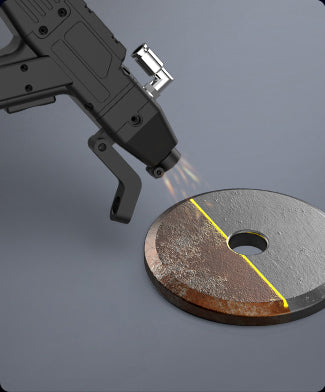
A fiber laser beam is absorbed preferentially by the contamination layer — rust, paint, oxide — which vaporizes or is ejected as particles. The base material absorbs less energy and remains largely intact. Because removal is selective and non-contact, dimensions are preserved and there is no abrasive residue.
Sandblasting: mechanical abrasion
Abrasive media (steel grit, glass bead, garnet, silica sand) is propelled at high velocity onto the surface. Contamination is removed by physical impact. The process simultaneously cleans the surface and creates surface roughness — an anchor profile useful for paint adhesion but a problem where tolerances must be held.
Chemical stripping: dissolution
Acid, alkali or solvent dissolves the contamination layer through chemical reaction. Full-surface contact is required, which makes it effective for batch processing and passivation but impractical for selective zone treatment or on-site work. Waste management is the main constraint.
Job-by-Job Decision Guide
This section covers the seven most common cleaning jobs in metal fabrication and industrial maintenance. For each job, the recommended method is given along with the reason — including cases where laser cleaning is not the best answer.
Job 1: Post-Weld HAZ Oxide Removal (Stainless Steel)
The heat-affected zone adjacent to a stainless steel weld develops a discolored oxide layer (blue, gold, brown or black bands). This must be removed to restore the corrosion-resistant chromium oxide surface and meet visual quality requirements.
For fabricators using handheld laser welding systems, the LCW series allows the same handheld unit to switch from welding to cleaning — so HAZ treatment happens directly at the weld station without moving the part. See also: stainless steel laser welding guide.
Job 2: Large-Area Structural Steel Rust Removal
Treating large surface areas — bridge girders, storage tanks, ship hulls, structural frames — where rust covers most of the surface and the main requirement is to get back to clean metal before recoating.
Honest note: For routine large-area blast cleaning on structural steel with good site access, sandblasting is often still more economical. Laser cleaning makes sense for this job when site conditions, waste management, or contamination type change the equation.
Job 3: Selective Paint or Coating Removal (Specific Zone)
Removing paint or coating from a defined zone — a weld repair area, a connector point, a marking zone, or an area requiring re-treatment — without disturbing the surrounding surface.
Job 4: Full-Surface Paint Stripping (Entire Part)
Completely stripping all paint or coating from a part before refinishing, re-coating, or repair — where the whole surface needs treatment, not just a zone.
Job 5: Mould, Die and Tool Cleaning
Removing carbon deposits, resin residue, release agent buildup, and surface fouling from injection moulds, die-casting dies, stamping tools and forming tooling — typically while the mould is still in the machine or minimally disassembled.
Job 6: Precision Components with Dimensional Tolerances
Cleaning parts where dimensional accuracy must be preserved — medical instruments, precision fittings, sensor housings, hydraulic valve components, aerospace fasteners. Any surface change from cleaning could cause the part to fail specification.
Job 7: Field Maintenance and On-Site Repair
Cleaning in the field — on-site equipment maintenance, pipeline repair, structural repairs where the component cannot be moved to a workshop. The method must be portable, practical in the field, and manageable without a full industrial facility.
The GWEIKE LCW handheld system is particularly practical for field maintenance because the same unit covers cleaning, welding and cutting — a single machine for multiple on-site tasks without the cost of separate equipment.
Cost and Productivity Comparison
The cost question is the one most users have and the one most articles avoid answering directly. Here is a realistic breakdown of cost structure for each method, without false precision.
Laser Cleaning
- Equipment: High upfront (1000W–3000W systems)
- Consumables: Near zero — no media, no chemicals
- Operator: 1 person, minimal PPE beyond eyewear
- Waste disposal: Fume extraction filter replacement only
- Facility: Fume extraction unit required
- Best economics: High-frequency use, precision work, field maintenance, post-weld HAZ
Sandblasting
- Equipment: Low to medium upfront
- Consumables: Ongoing media purchase (steel grit, garnet, etc.)
- Operator: 1–2 people, full dust PPE required
- Waste disposal: Spent media (hazardous if lead paint present)
- Facility: Blast room, dust collection, containment
- Best economics: Large surface area, structural steel, pre-paint prep
Chemical Stripping
- Equipment: Medium upfront (tanks, ventilation)
- Consumables: Ongoing chemical purchase and replenishment
- Operator: 1 person, chemical handling qualification needed
- Waste disposal: Spent chemicals, rinse water — usually regulated disposal
- Facility: Ventilation, chemical storage, waste water treatment
- Best economics: Batch processing, full-surface immersion, passivation
The break-even point between laser cleaning and sandblasting depends on frequency of use, job type, local labour costs, energy costs, and equipment utilisation rate. Facilities doing post-weld HAZ cleaning repeatedly throughout each working day typically find that lower consumable and labour costs offset the higher equipment investment over time — but the actual payback period varies significantly by application and operating context. A facility that only does occasional large-area blast cleaning once a month is unlikely to justify the laser system on economics alone. For a realistic cost comparison, calculate based on your own volume, current cleaning costs, and waste disposal expenses.
Safety and Environmental Factors
Operator safety
Laser cleaning systems operate as Class 4 lasers. Mandatory safety requirements include: laser safety eyewear rated for the operating wavelength (1070 nm for fiber laser systems); a controlled work area that restricts access to non-operators during operation; removal or shielding of reflective surfaces from the beam path; and adequate fume extraction to capture vaporized contamination. Operators should receive equipment-specific training before use, and all applicable workplace laser safety regulations must be followed — refer to the equipment manufacturer’s safety manual for complete requirements. By contrast, sandblasting requires full respiratory protection (NIOSH-rated respirator), hearing protection, protective clothing and gloves. Silica sand blasting in particular carries long-term silicosis risk; many jurisdictions restrict or ban silica sand for abrasive blasting for this reason, and alternative media such as steel grit or garnet is commonly used instead. Chemical stripping requires chemical-resistant PPE, respiratory protection from fumes, operator training in chemical handling procedures, and formal arrangements for waste disposal.
Waste and environmental compliance
Laser cleaning produces fumes that must be captured by an extraction system, but no chemical waste and no abrasive media to dispose of. Sandblasting produces spent abrasive media — if the removed contamination includes lead-based paint or heavy metal coatings, the spent media becomes classified hazardous waste with specific disposal requirements. Chemical stripping generates spent acids or solvents that almost always require formal waste disposal reporting and licensed carrier collection.
Clean environment compatibility
For food production, pharmaceutical manufacturing, medical device assembly and electronics, laser cleaning is the only practical option among these three methods. Abrasive contamination from sandblasting and chemical residues from stripping agents are unacceptable in regulated clean environments. Laser cleaning, with proper fume extraction, leaves no residue on the part surface.
When Sandblasting Is Still the Better Choice
This section exists because honest guidance is more useful than one-sided promotion. Laser cleaning is not the right answer for every job, and a credible comparison acknowledges that.
Sandblasting remains the better or equal choice in the following situations:
- Large-area structural rust removal where throughput per hour matters and the facility has a blast room with media handling infrastructure already in place.
- Pre-paint surface preparation on structural steel where the coating system specification requires a specific anchor profile (Sa 2.5 or Sa 3 per ISO 8501-1). Laser cleaning preserves the existing surface profile — it does not create the roughness that industrial coatings often require.
- Very low frequency use where the volume of cleaning work cannot justify the capital investment in a laser system.
- Facilities that already have full sandblasting infrastructure and no regulatory pressure on waste management — the incremental cost of continuing to blast is low.
- Surfaces where uniform roughness is a functional requirement (not just for paint adhesion, but for the part function itself — certain bearing surfaces, friction applications).
The real question is not "which method is better" in general — it is "which method is better for this specific job, facility, and volume." Both sandblasting and laser cleaning have strong applications; the choice depends on matching the method to the actual requirements.
When Chemical Stripping Is Still the Better Choice
Chemical stripping also retains genuine advantages in certain applications and should not be dismissed simply because it produces waste.
- Full-surface passivation of stainless steel — immersion acid pickling and passivation per ASTM A967 or similar standards is often specified in food-grade and pharmaceutical fabrication contracts. Laser cleaning does not replace a formal passivation process where one is contractually or regulatorily required.
- High-volume batch descaling — for large quantities of small parts requiring full-surface oxide removal (fasteners, fittings, heat-treated components), immersion processing is typically more efficient than scanning each piece individually with a laser.
- Deeply embedded contamination — certain contamination types (specific adhesive residues, some industrial coatings) respond better to chemical dissolution than to laser ablation. Always test on a sample piece if the contamination type is unfamiliar.
- Facilities with existing chemical processing infrastructure — if waste treatment, chemical storage, and regulatory compliance are already established, the incremental cost of continuing chemical processing may be lower than switching to a new technology.
The choice between laser cleaning and chemical stripping is not about which technology is inherently superior — it is about which method best fits the specific contamination type, volume, facility constraints and compliance requirements of the job.
If You Choose Laser Cleaning: Which System?
Once you have determined that laser cleaning fits your application, the next decision is which type of system to use.
Handheld 3-in-1 systems (cleaning + welding + cutting)
The GWEIKE LCW series is designed for fabrication shops and maintenance teams that need flexibility. One system handles laser cleaning, laser welding and laser cutting by switching processing heads. This is practical for:
- Fabricators who already use laser welding and want to add post-weld HAZ cleaning without separate equipment
- Maintenance teams handling mixed tasks — cleaning, welding repairs, cutting
- Field service operations where carrying multiple machines is impractical
- Smaller workshops where floor space and capital are limited
Power selection: 1000W vs 1500W vs 3000W
| Power | Best for | Typical applications |
|---|---|---|
| 1000W | Post-weld HAZ cleaning, mould cleaning, precision parts, light rust | Stainless steel fabrication, food equipment, electronics housings |
| 1500W | Moderate rust removal, paint stripping, higher throughput cleaning | General fabrication, maintenance shops, mixed cleaning and welding |
| 2000W–3000W | Heavy contamination, large surface area per shift, production line integration | Heavy industry maintenance, automotive, high-volume fabrication |
If your primary application is post-weld HAZ treatment on stainless steel, 1000W is typically sufficient and provides good process control. If your workload includes heavier rust removal or higher daily throughput, 1500W gives more practical headroom. Contact us with your specific material and contamination type to confirm the right configuration for your production conditions.
Need Cleaning, Welding and Cutting in One System?
The GWEIKE LCW series combines all three in a single handheld unit — 1000W to 3000W configurations for fabrication shops, maintenance operations and field service.
Helpful to include when enquiring: material type, contamination type (rust / paint / oxide / mould fouling), estimated surface area per shift, and whether you need cleaning only or combined with welding.FAQ
Is laser cleaning faster than sandblasting?
It depends on the job. For post-weld HAZ cleaning, mould cleaning, and precision parts, laser cleaning is typically faster and more practical. For large-area structural rust removal, sandblasting generally covers more area per hour. Laser cleaning is most efficient for small-to-medium areas, complex geometry, and jobs where precision or waste management matters.
Does laser cleaning produce a surface suitable for painting?
Laser cleaning removes contamination and leaves a clean metal surface, but does not create the roughness profile that sandblasting does. For applications requiring a specific anchor profile for heavy industrial coatings — particularly on structural steel — sandblasting is usually the better preparation method. For thin coatings, precision parts, or applications where the existing surface profile must be preserved, laser cleaning is suitable.
Can laser cleaning remove heavy rust?
Laser cleaning can remove surface rust and moderate rust layers effectively. For heavy pitting corrosion where the rust has penetrated deep into the steel, the pit profiles will remain even after cleaning — laser cannot restore base material that corrosion has already consumed. For deeply pitted structural steel, sandblasting may be more efficient.
What are the running costs of laser cleaning compared to sandblasting?
Laser cleaning has higher equipment investment but near-zero consumable costs — no abrasive media to purchase or dispose of. Sandblasting has lower equipment cost but ongoing media, PPE, and disposal expenses. For high-frequency precision cleaning (HAZ treatment, mould cleaning, field maintenance), laser cleaning typically becomes more cost-effective over time. For occasional large-area blasting, sandblasting may remain more economical.
Is laser cleaning safe to use in food production or pharmaceutical environments?
Yes. Laser cleaning produces no chemical residue and no abrasive particles that could contaminate products. With proper fume extraction, it is suitable for food-grade, pharmaceutical and medical manufacturing environments where chemical agents and abrasive contamination are unacceptable. Verify fume extraction capacity matches the specific materials being cleaned.
Can one laser system handle both cleaning and welding?
Yes. Multi-function fiber laser systems such as the GWEIKE LCW series combine cleaning, welding and cutting in a single handheld unit by switching processing heads. This is practical for fabrication shops that want to add post-weld HAZ cleaning without a separate dedicated machine.
When should I choose sandblasting over laser cleaning?
Sandblasting remains the better choice when treating large surface areas of structural steel where throughput matters most; preparing surfaces for heavy industrial coatings requiring a specific anchor profile; working in facilities with established blasting infrastructure; and when equipment investment budget is limited. The correct method depends on the specific job — this guide exists to help make that decision rather than assuming laser always wins.
Is laser cleaning better than sandblasting for stainless steel weld cleaning?
Yes, for post-weld HAZ oxide removal on stainless steel, laser cleaning is generally the better choice. Sandblasting embeds abrasive particles into the stainless surface, creating sites for crevice corrosion — which is particularly problematic in food-grade, marine or chemical processing environments. Laser cleaning removes the oxide layer selectively without abrasive contact, preserving the corrosion-resistant chromium oxide surface. Chemical acid pickling is also effective but requires waste handling and is impractical for in-situ work.
Does laser cleaning damage or affect the base metal?
When parameters are correctly matched to the material and contamination type, laser cleaning removes the contamination layer while leaving the base metal largely unaffected. Incorrect parameters — such as too high power, too slow scan speed, or an unsuitable frequency setting — can cause surface discoloration or minor thermal effects on the substrate. This is why sample testing and parameter validation before production cleaning are important, particularly on sensitive materials or thin sections.
Can laser cleaning create an anchor profile for painting?
No — laser cleaning preserves the existing surface profile but does not create the roughness profile that sandblasting produces. If a coating system specification requires a specific anchor profile (for example, Sa 2.5 or Sa 3 per ISO 8501-1, or a specific Ra value), sandblasting or mechanical abrasion is the correct preparation method. Laser cleaning is appropriate for applications where the surface should be cleaned without profile change, or where thin-film or precision coatings are applied.