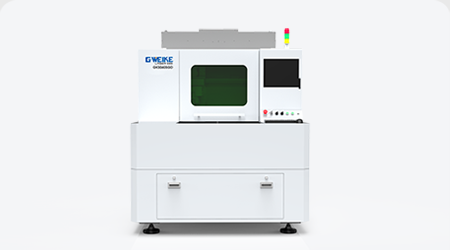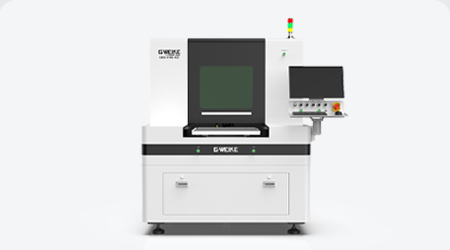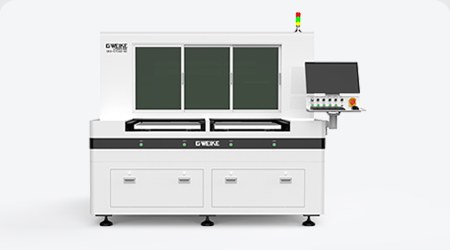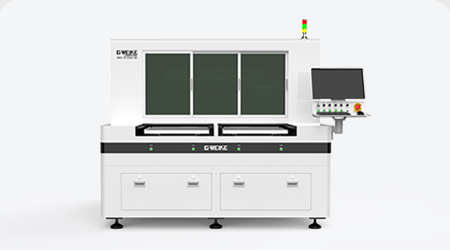
Ultrafast laser cutting platform · 8 application-matched machines

Sub-10μm chipping on cover glass
500mm/s production speed
for glass, films, FPC & PV glass

High-precision ultrafast laser cutting from smartphone cover glass with ≤10μm typical chipping on selected applications to roll-to-sheet PI and PET film — GWEIKE matches picosecond, UV / green, MOPA and CO₂ laser configurations to each material and production target.

≤10μm
Selected glass chipping
500
mm/s linear speed*
±0.002
mm repeatability*
8
Machine configurations

*Performance varies by model, material, thickness, fixture and process settings. Verify final results with a sample test.

01 / Start here

Choose by what you need to process

Most buyers do not start with a machine model. They start with a material, a thickness range and a yield target. These three paths help procurement teams and process engineers narrow the platform quickly.

Cover glass & consumer electronics

Smartphone, smartwatch, camera cover, sapphire and display glass applications — high-precision glass cutting where edge strength and low chipping affect yield.

2+ machines 0.1–1.4 mm glass ≤10μm typ. chip*

Thick, industrial & PV glass

Automotive displays, home appliance glass, security glass, PV backsheet glass and production-line drilling or splitting workflows.

4 machines ≤12–15 mm Cut / split / drill

FPC, PCB & functional films

High-precision UV / green picosecond laser cutting for FPC shaping, rigid-flex boards, PI film, PET film, OCA film, polarizer and roll-to-sheet automated cutting.

3 machines UV / CO₂ ±0.03–0.05 mm
02 / 30-second selector

Get a first machine recommendation before you send samples

This selector is not a final engineering quotation. It helps your team choose the right starting point for discussion and sample testing.

Get my machine

Recommended starting point

Select your material, thickness and production goal, then click Get my machine.

03 / Process logic

Why ultrafast laser selection depends on material, not only power

Glass, functional films and electronics substrates fail in different ways: chipping, microcracks, carbonization, heat affected zones or alignment errors. That is why the platform uses different laser sources and motion configurations.

Process route Typical edge issue Thermal effect Positioning focus Best-fit applications
Mechanical wheel / diamond Higher chipping risk Low heat, mechanical stress Tool wear control Low-cost flat panels
CO₂ laser film cutting Kerf control Material-dependent Roll feed / CCD alignment PI, PET, OCA, polarizer
UV / green picosecond No burr / no carbon target Low thermal impact Galvo and dual platform FPC, PCB, camera module
Picosecond glass cutting / splitting Low chipping target Low microcrack risk High repeatability Cover glass, thick glass, display glass

Values and outcomes depend on material grade, thickness, fixture, optics, process window and inspection method. Use sample testing for final validation.

04 / The platform

Eight machines, four laser configurations, one supplier

Filter by laser source or application. Each card shows the key numbers that help engineers and procurement teams decide which product page to review first.

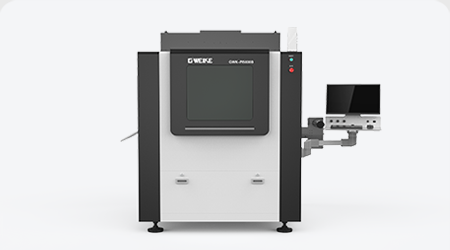
GKS-0605-GD precision glass drilling machine
GKS-0605-GD
Precision glass drilling machine
532 / 1064nm Drill
Thickness≤15mm
Chipping60–300μm
Scan speed8000mm/s
Accuracy±0.03mm

Best for: Cover glass holes, appliance glass, electronic glass substrates, backlight glass and thin-film solar substrates.

GKS-0706-GC thick glass cutting and splitting machine
GKS-0706-GC
Thick glass cut + split
Picosecond IR CO₂ split
Thickness≤12mm
MicrocracksLow risk
Speed500mm/s
Accuracy±0.01mm

Best for: Automotive displays, smart appliances, security glass and smart-home glass panels requiring controlled splitting.

GSK-0706D-GC dual-platform front cutting back splitting machine
GSK-0706D-GC
Dual-platform cut + split
Picosecond IR CO₂ split Dual-Platform
Thickness≤12mm
Worktables2 × 400×500
Speed500mm/s
Accuracy±0.02mm

Best for: High-volume thick glass production using front cutting and back splitting to improve line throughput.

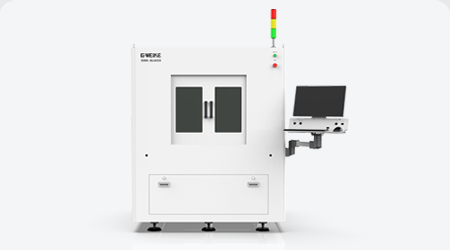
GWK-UV4065 dual-platform UV and green laser cutting machine
GWK-UV4065
UV / green precision cutter
UV ps · 355nm Green ps · 532nm Dual-Platform
Thickness≤2mm
EdgeNo carbon
Scan speed6000mm/s
Accuracy±0.03mm

Best for: FPC shaping, rigid-flex PCB depaneling, camera modules and fingerprint recognition module cutting.

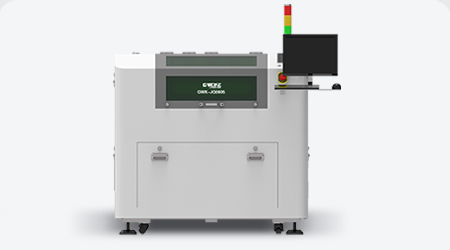
DC0605 roll-to-sheet PI film laser cutting machine
DC0605-PI
Roll-to-sheet PI film cutter
Sealed CO₂ Roll-feed Automatic Intelligence
Film thickness≤1mm
Kerf80–150μm
Speed300mm/s
Accuracy±0.05mm

Best for: FPC coverlay film, polyimide film and electromagnetic shielding film in automated roll-to-sheet workflows.

DC0605 PET film laser cutter for OCA polarizer and screen protectors
DC0605-PET
PET film cutter
Sealed CO₂ CCD align
Film thickness≤1mm
Kerf80–150μm
Speed300mm/s
Accuracy±0.05mm

Best for: OCA film, polarizer, screen protectors and DTF PET film where CCD print-to-cut alignment is needed.

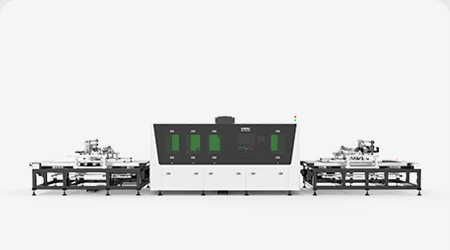
GKS-1210-GD photovoltaic glass punching machine
GKS-1210-GD
PV glass punching line
MOPA × 3 heads Automated processing
Glass thickness≤2.5mm
Sheet size≤2500×1500mm
Cycle≤6s/hole
Accuracy±0.1mm

Best for: PV backsheet glass punching, embossed glass, automotive glass and camera cover drilling with production-line integration.

05 / Selection guide

How to choose an ultrafast or precision laser cutting machine

A good selection process should start from the part, not from the laser source name. Use the questions below to prepare a technical inquiry or sample test.

Which laser source is best for cover glass cutting?

Picosecond IR laser cutting is commonly used for cover glass, sapphire camera covers and display glass where low chipping, edge strength and repeatable non-contact processing are required.

Is precision laser cutting the same as ultrafast laser cutting?

Precision laser cutting is a broader category that includes UV nanosecond, fiber and CO₂ systems. Ultrafast (picosecond / femtosecond) is a sub-category designed for brittle and heat-sensitive materials where every micron of edge quality matters.

When should I choose CO₂ for film materials?

CO₂ sealed laser systems are suitable for PI film, PET film, OCA film and polarizer materials where roll-to-sheet automation, stable kerf width and clean edge appearance are important.

What information is needed for a sample test?

Material type, thickness, drawing file, tolerance requirement, edge quality target, inspection method and expected production volume help engineers recommend the right machine and process window.

How do I evaluate a high-precision glass cutting machine?

Compare four numbers from a real sample cut: edge chipping (microns), microcrack depth, four-point bending strength, and cycle time per part. Spec sheet numbers without a measured sample report are not enough for production qualification.

Can one machine cut all glass and film materials?

No. Brittle glass, thick glass, FPC, PI film, PET film and PV glass drilling require different laser sources, optics, motion platforms and fixtures.

06 / Built on

Two decades of laser manufacturing and application testing

GWEIKE built the world's most powerful industrial fiber laser at 135 kW. The same R&D team, supply chain and global service network back every machine in this ultrafast platform — Powering Precision, Shaping the Future.

135kW
World's most powerful industrial fiber laser
2004
Founded · 20+ years
180+
Countries served
200K
Production area
20K+
Units shipped annually
130+
Patents granted
Certified & recognized by iF Design Award 2024 CE FDA ISO 9001

Send your material. Validate the process before buying.

Share your material type, thickness, drawing file, tolerance target and production goal. GWEIKE application engineers can recommend the right precision laser configuration and discuss sample testing or quotation details.

Material-based model advice Sample test discussion Process parameter review NDA available on request